Table of Contents
The Search Landscape Has Changed Forever
It has been easy to conduct SEO work for more than two decades now. All that someone would need to do is rank well on Google, get lots of clicks, and make money. All that will no longer be the same in 2026.
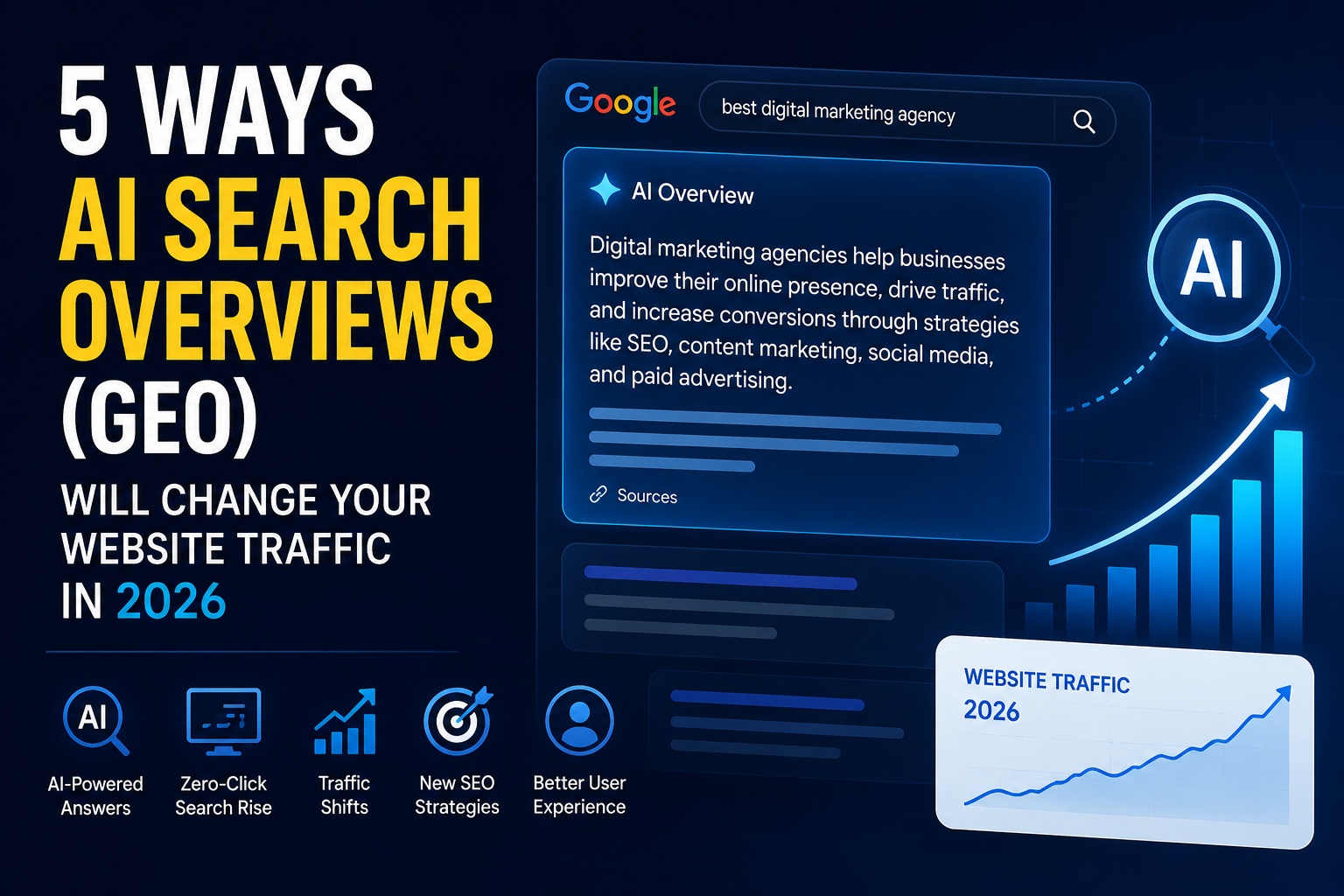
The introduction of AI Overviews, AI Mode, and Generative Engine Optimization has made searching on the internet totally different. Instead of going through the initial few blue links, people are getting AI answers to their questions. This has introduced both challenges and opportunities for those organizations that want to remain relevant online.
As some sites lose relevance to AI, others benefit from the introduction of new techniques such as GEO. Companies need to know the effects that AI Search Overviews can have on website traffic in the future. The following are the top five effects that you should be aware of in 2026.
What Are AI Search Overviews?
AI Search Summary is a brief created by artificial intelligence that is included in the search result itself. The necessity to visit multiple sites is substituted by AI on Google gathering information from various sources and providing one succinct answer.
In the case when one performs a search like,
"What is the role of predictive maintenance in reducing manufacturing expenses?"
Google will first show the generated piece of information and then other search results.
There will be no necessity to click anywhere to find the desired information; such a technique is known as zero-click search. Numerous industry reviews and scientific research prove that AI-based searches are influencing clicks and traffic for informational queries in a major way.
That is when GEO (Generative Engine Optimization) comes into play.
In contrast to SEO, GEO aims at making the content easily accessible, understandable, and referenced by AI.
1. Organic Traffic Will Become More Selective
The other one of the most impactful changes affecting the business sector will be a drop in the number of low-purchase-intent visits.
Before, users used to follow the link of the search result in order to receive basic information about the subject of their query. At the moment, thanks to the AI Overviews by Google, they get the necessary answer right on the search results page.
There have been many experiments that show the significant reduction in click-through rates for AI Overviews on informational queries, ranging from 15% to nearly 40% depending on the query type and the business category.
Example
Let's take a cybersecurity consulting company.
Before, articles like "What Is Endpoint Security?" might attract hundreds, maybe even thousands of visits each month.
Now, the AI Overview gives them a summary, so the majority of those searches would not end with a visit to your website.
What It Means
The traffic volume might be lower, but the quality of visitors is much higher. It means that instead of focusing just on traffic, the business should focus on:
- Qualified visitors
- Lead generation
- Engagement metrics
- Conversion rate
Qualification wins over quantity in 2026.
2. Authority and Expertise Will Matter More Than Rankings
Earlier, SEO favored those sites that used keywords best. AI-powered search engines favor websites that exhibit authority, expertise, and trustworthiness.
When assessing websites, Google's AI algorithms will factor in:
- Domain expertise
- Expert credentials
- Branding
- Content quality
- Source authority
Findings in "AI Overview" have shown that reputable domain and source authorities are typical sources of information.
Example
Let us assume we have two articles about AI automation technology:
Article A
- Poor quality of content
- No details regarding authorship
- No examples included
- Insights offered are poor in quality
Article B
- Written by an AI expert/consultant
- Examples provided
- Statistics offered relating to various industries
- Practical examples offered
The latter article would most probably be favored by AI search engines.
What Businesses Should Do
Prioritize:
- Articles by experts
- Insights into industry
- Research work
- Case studies by clients
- Thought leadership
Those brands that can establish authority would most probably make it to AI search results.
3. Citation Visibility Will Become the New Ranking Metric
The practice of using rankings to measure success is not new. In GEO time, the criterion of success will be citation by the AI system. Being cited in an AI Overview would make you famous without necessarily driving traffic to your website.
Example
Suppose a logistics-oriented software company writes a long article on:
"The Role of AI in Enhancing Predictive Capabilities within the Logistics Chain."
Google AI Overview would extract information from the article and cite the company as a trustworthy source.
The outcome will be:
- Brand fame increase
- Credibility improvement
- Greater trust among prospects
- Higher chances of branded search in the future
The new question
Quit asking:
"Are we at the top of the search engine results?"
Start asking yourself:
"Do the AI systems cite us?"
4. Long-Tail and Conversational Queries Will Drive More Valuable Traffic
Searches using artificial intelligence are influencing the manner in which people conduct searches.
The trend is moving away from using short keywords to asking complex questions.
These include:
"What are some suitable CRM applications for manufacturing companies employing fewer than 500 employees?"
"How does AI minimize forecast inaccuracies for inventory management?"
"What are the benefits of having workflow automation in the health care industry?"
Why This Matters
Content that is designed to solve particular questions is content that works well with AI-driven systems.
Content that organizations should generate is the kind that is designed to:
- Solve real-world problems
- Answer entire questions
- Have natural language
- Cover all aspects of a given topic
Example
Rather than:
"Cloud migration"
Generate content on:
"How to migrate enterprise applications to the cloud without any downtime."
The latter is more suited to AI-based search experiences.
5. GEO Will Become as Important as Traditional SEO
Indeed, many businesses regard AI search as an emerging trend for the future.
However, at the same time, it has already revolutionized the process of traffic acquisition.
Generative Engine Optimization (GEO) stands for AI's comprehension, trustworthiness, and citations of your content.
Main GEO Techniques to Apply by 2026
Create Answer-Focused Content
AI systems prefer content that provides clear, direct answers.
Structure Information Clearly
Apply these methods:
- Header
- Bullets List
- FAQ Page
- Table
- Definition
Thus, it becomes understandable for AI.
Build Topic Authority
Concentrate not on certain keywords but on a topic as a whole.
Create Fresh Ideas
Unique ideas are often based on fresh data and new research.
Strengthen Your Brand Signals
References, case studies, mentions, and even reviews increase credibility.
As practice has shown in the sphere of publishers and their industries, websites whose content has been optimized specifically for AI have significant advantages compared to others that still apply SEO tactics.
How Businesses Can Prepare Right Now
The successful businesses in the year 2026 won’t be those fixated on ranking. They’ll be the ones that prioritize authority.
This is how you can start:
Content Audit
Revamp current content targeting informational keywords to include better insights.
Utilize Expertise
Showcase your team’s expertise through expert-written content or case studies.
Topic Cluster Architecture
Create content ecosystems rather than individual pieces.
AI-readability Content
Ensure your content has proper structure and provides clear answers.
Brand Visibility
Watch out for mentions, citations, and brand searches; don’t just look for rankings.
Conclusion
AI Search Overviews are fundamentally changing how users interact with search engines. While it is true that some companies might struggle with poor organic traffic, companies using GEO technology will find themselves gaining a new advantage.
Generating clicks won’t be important for tomorrow’s search engines. Instead, tomorrow’s search engines will focus on being the reference point for credible AI. The companies that are focusing on information dissemination through AI and digital marketing today are the ones that will be reaping the rewards in the future.
SolvitX helps businesses adapt to this environment by using cutting-edge technologies such as AI, digital transformation, and AI search optimization.
Frequently Asked Questions (FAQs)
1. What is Generative Engine Optimization (GEO)?
Generative Engine Optimization (GEO) is the process of optimizing content in a manner that makes it easily understandable and useable by AI-powered search engines and AI assistants. The usual practice of SEO to optimize search engine results to rank sites will be different in that it focuses on optimizing content within search engines' answers.
2. How can businesses utilize content optimization for AI Overviews?
To ensure that your business is talked about in AI overviews, you need to do the following:
- Create detailed and correct content.
- Provide explicit answers to queries.
- Use brief headings and correct structure.
- Build authority.
- Share insightful research and case studies relating to the industry.
- Update the content regularly.
3. What type of content works best for AI Overviews?
The type of content that provides details, opinions from experts, examples, FAQs, research findings, case studies, and tutorials generally works best for AI Overviews.
4. Which industries would be more affected by AI Search Overviews?
The industries whose marketing relies heavily on informational content, including technology, SaaS, health care, financial services, education, consulting, and professional services, are bound to see greater shifts in marketing. But all companies, regardless of their industry, that operate online should be ready for these changes.

Kanika Kapoor
Digital Marketing Strategist
Expert in Development with a passion for sharing knowledge and insights. Follow for more articles on AI Search, AI Overviews, GEO, SEO.